Tuesday, April 14, 2015

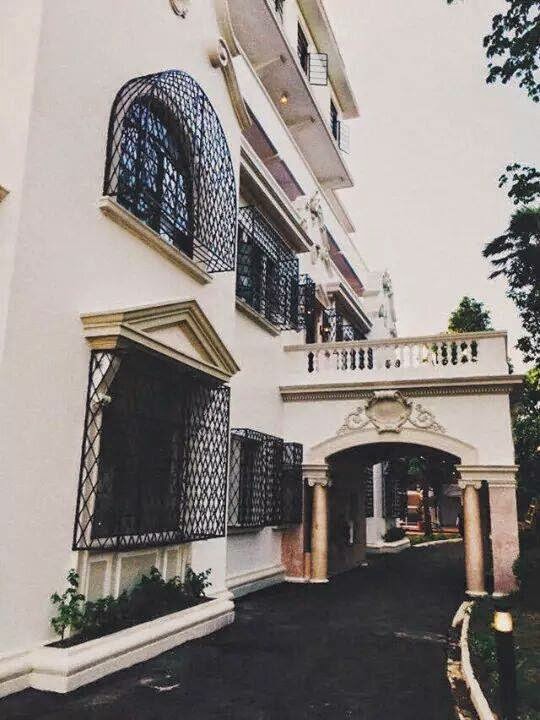
The New Look of Villaroman Mansion

The Villaroman Mansion is one of the most interesting heritage mansions along Roxas Boulevard and it is now being restored.

Rumour has it that this house was formerly owned by the Lopezes, according to the article "Lopez Ruby Wedding Anniversary".

Here is a look at the new Villaroman Mansion, courtesy of JC Contapay.


  This is the back view of the Villaroman Mansion


According to the Manila Nostalgia (Facebook Group) this Villaroman Mansion is owned by Dr. Francisco Villaroman, and according to great grandson of  Dr. Francisco Villaroman, Mr.Gilbert Villaroman, "This was not Eugenio Lopez, Sr.'s home. This was our ancestral home which was built by my late (great?) grandfather Dr. Francisco Villaroman, Sr. The left side faces Roxas Blvd. Our property wall used to be where the Manila Bay was until the reclamation project which created the road which is now Roxas Blvd... There was [an elevator] on the property and it was placed to assist my grandfather who in his later years had difficulty walking due to a stroke."

The aerial shoot of Villaroman Mansion.
Unknow date of shoot
(c) Page Osorio

Here one night shot from Darwin Cayetano of the Villaroman Mansion

The majestic beauty of the mansion during night
Another look inside the Villaroman Mansion photo courtesy of Camila Lhullier 


Currently this mansion is owned by the Lhullier family according to Carlos Celdran post in facebook account.

If you have any information regarding the Villaroman Mansion along Coastal Road, please care to share with us.

Written by : Axl Guinto
Edited by : Charmaine Yves Chong

Friday, April 10, 2015

Artist's Rendition of the Proposed Rizal Cultural Shrine Manila, 1963

Photo shows the completed artist rendition of the proposed Rizal Cultural Shrine that was supposed to be constructed in 1963 during the centennial of the birth of Jose Rizal. Seen here is the Rizal Monument with its aluminum pylon and brilliantly-lit area; the National Library (left), the National Theater (middle) and the National Museum. Of the three building, only the National Library was constructed with much delay.

Artist's Rendition of the Proposed Rizal Cultural Shrine Manila, 1963

Young Men's Christian Association (YMCA) Building, ca. early 20th century

The YMCA came to the Philippines in 1898. When the American Army in Manila moved to Fort William McKinley in February, 1905, an independent association for Manila was organized under the direction of the Army and Navy departments made a formal request to the YMCA International Committee in New York City for assistance. In 1907, John R. Mott, general secretary of the foreign department, visited Manila and met with the directors and interested friends where it decided to conduct a campaign for funds for an adequate and permanent association. Mott guaranteed P170,000 for the construction of a building on condition that friends in the Philippines secure the site and adequately furnish the building. The campaign for funds was begun here on February 15, 1907, and, by the 15th of March following, P83,000 was subscribed, nearly one thousand different persons contributing. Thereupon the Young Men’s Christian Association of Manila was incorporated under the law of the Philippine Islands and received its character in June, 1907. A site for the new building was selected on Calle Concepcion, Ermita, and the building contract was let on the 8th of January following. The cornerstone was laid with appropriate ceremonies on July 10, 1908, and the building was formally dedicated on October 20, 1909.

Young Men's Christian Association (YMCA) Building, ca. early 20th century. Concepcion St. (now Natividad Lopez-Almeda St.), Ermita, Manila

Tuesday, April 7, 2015

A Very Short History Of The Colegio De San Jose

In 1601, the Rector of the Colegio de Manila i, Fr. Pedro Chirino, organized the Colegio de San Jose to
serve as the former’s extension school.ii The Colegioiii, aside from being an extension college, also served
as a grammar school where latin and Catholic morals were taught.iv In 1768, the Society of Jesus was expelled and their properties in the colonies, including San Jose, were taken from them.v After the Jesuit expulsion, the administration was given to the secular clergy.vi It was during this secular administration that Paciano, the brother of Jose Rizal, studied Segunda EnseƱanza and graduated with a Bachiller en Artes from San Jose.vii
Image 01: The main entrance to the building of the Facultades de Medicina y Farmacia, Colegio de San 
Jose, Universidad de Santo Tomas, 1887.xvi

Wednesday, April 1, 2015

Heritage Alert : St. Aloysius Gonzaga Church an on-going obstruction

St. Aloysius Gonzaga Church popularly know as  San Luis Gonzaga Church is one of the oldest churches you will find in the culinary capital of the Philippines, Pampanga.

St. Aloysius Gonzaga Church
 St. Aloysius Gonzaga Church was no information exists as to when the church was built, but it must have been completed in the late 18th century. In 1883, the church was restored by Fr. Isidro Bernardo, which then had the following dimensions: 56 meters long, 13 meters wide and 11 meters high. The church convent was expanded by Fr. Francisco Diaz in 1877. Today, San Luis Church is one of the few churches in the province that retains its old-world authenticity, even after assiduous restorations, one as recent as 1984 done on the retablo mayor, undertaken by Fr. Jacobo David.
Related Posts Plugin for WordPress, Blogger...

Ads Inside Post